ecobc Restoration and Maintenance StrucTek Consulting Ltd.
Managing Exterior Building Components
Christian
1 / 27
CPE seminar for property managers

Managing Exterior Building Components

Life cycle, deterioration, and smarter decisions — how the outside of a building ages over forty years, what to watch for, and when each element needs attention.


Christian Coldea
President, ecobc Restoration and Maintenance
Ali Shahbazi, P.Eng., LEED AP
Owner and Principal Engineer
CMRAO CPE · 2 credits60 minutesInteractive 3D building
Drag the building to spin itto begin?keys
What you'll leave with

Six lessons, one hour.

  • Know the exterior elements that matter most — and what each one actually does
  • Understand why they deteriorate, and why Ontario's climate accelerates it
  • Recognize the early warning signs on an ordinary property walk
  • Know typical service-life ranges — and why observed condition beats the table
  • Tell the difference between maintenance, localized repair, and rehabilitation
  • Work more effectively with engineers and contractors: what to ask, what to compare
Why this matters in your role

Bring value to the board by applying your perspective.

Managers who understand deterioration and life cycle make better recommendations, budget more accurately, and have far fewer uncomfortable surprises at AGMs.

Board communication

Explain condition, risk and options in plain language — and be the person in the room who can push back.

Budgeting

Plan repairs proactively instead of reacting. Emergency work costs the corporation the most.

Repair timing

Intervene at the right moment. Every element has a window where the fix is a maintenance item, not a capital project.

Lifecycle cost

The right decision at the right time costs less over the life of the building — every time.

Stewardship

Protect the common elements and the residents' investment. Protect your own reputation while you do it.

Fewer surprises

Identify risk early enough that the board hears about it from you, on your timeline — using what you see on site.

The more a manager understands building deterioration and life cycle, the more value they bring to the board.

One building, five zones

Everything we'll talk about is on this building.

  • Facade — sealants, windows, cladding, movement joints, concrete
  • Balconies — slab, railings, membrane
  • Roof — membrane, parapet, anchors
  • Garage — deck membrane, traffic coating, joints, drains, columns
  • Below grade — foundation walls

Every glowing marker is an element. We'll open each one and watch it age from new to year 40.

Why buildings deteriorate here

Ontario is one of the hardest climates for building envelopes.

Three of these are genuinely about where we build. The rest happen everywhere.

Thermal movement

Concrete, brick, metal and glass expand and contract at different rates. Our swing from −25 °C to +35 °C is far wider than most climates, and every joint carries that stress all year.

Freeze–thaw

Water enters a hairline crack, freezes and expands, thaws, lets more water in. We get dozens of these cycles a season — they pry the crack open for you.

De-icing salt

Tracked into every garage all winter and thrown at every column base. Salt is what turns ordinary moisture into active corrosion of the steel.

And everywhere, not just here: UV degradation of sealants, coatings and membranes · moisture infiltration, the common thread in almost every failure · deferred maintenance, accidental damage and ordinary wear.

Sealants and movement joints

Sealants are not cosmetic.

  • Buildings can't be rigid. Joints let them move, and sealants keep water out while they do
  • Field experience: many joints have failed by year 10, and most by year 20
  • Same curve everywhere it appears: window perimeters, expansion joints (8–15 yrs), glazing gaskets (10–18 yrs)
  • A failed joint is an open water pathway, not a cosmetic defect
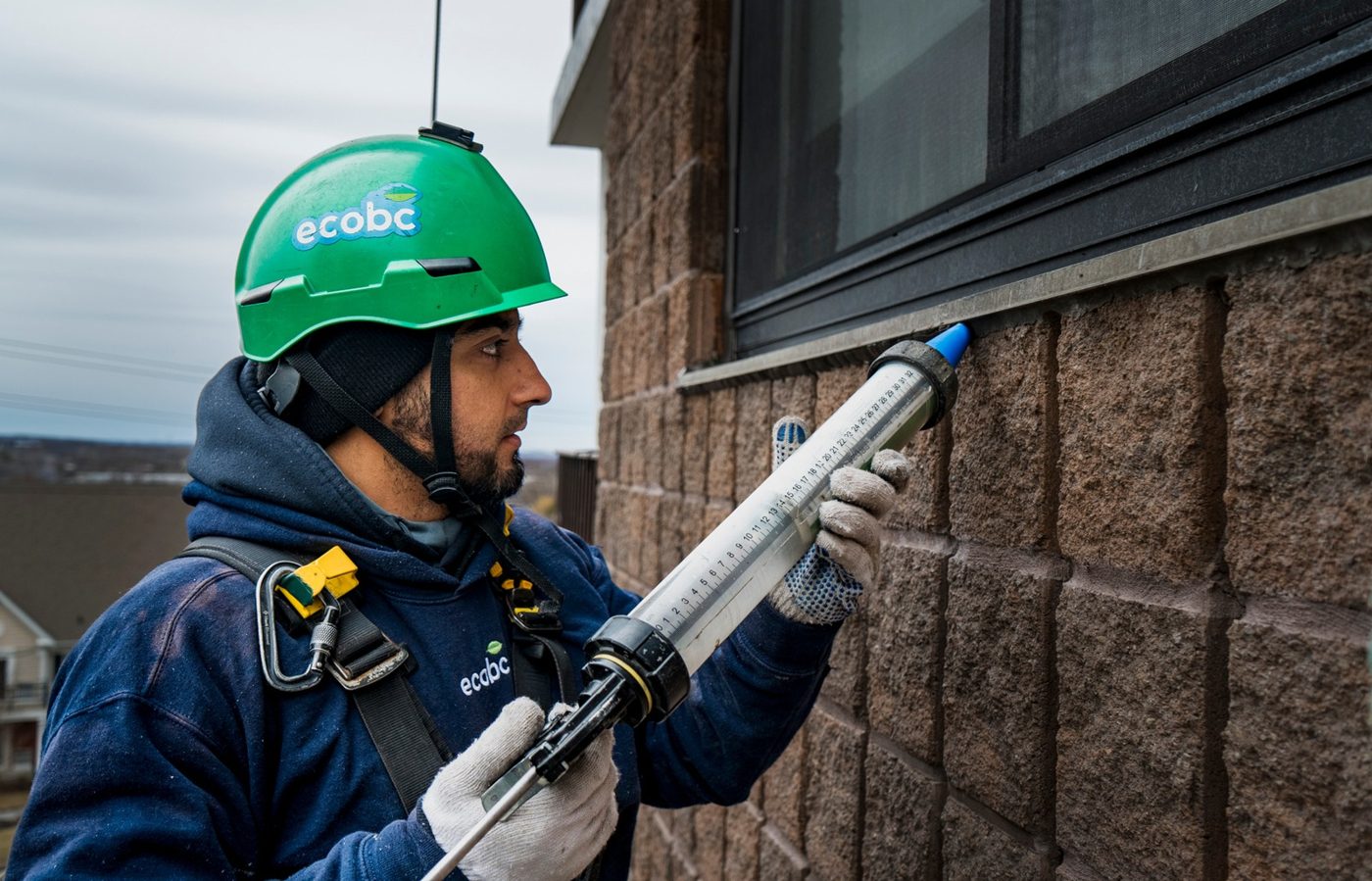
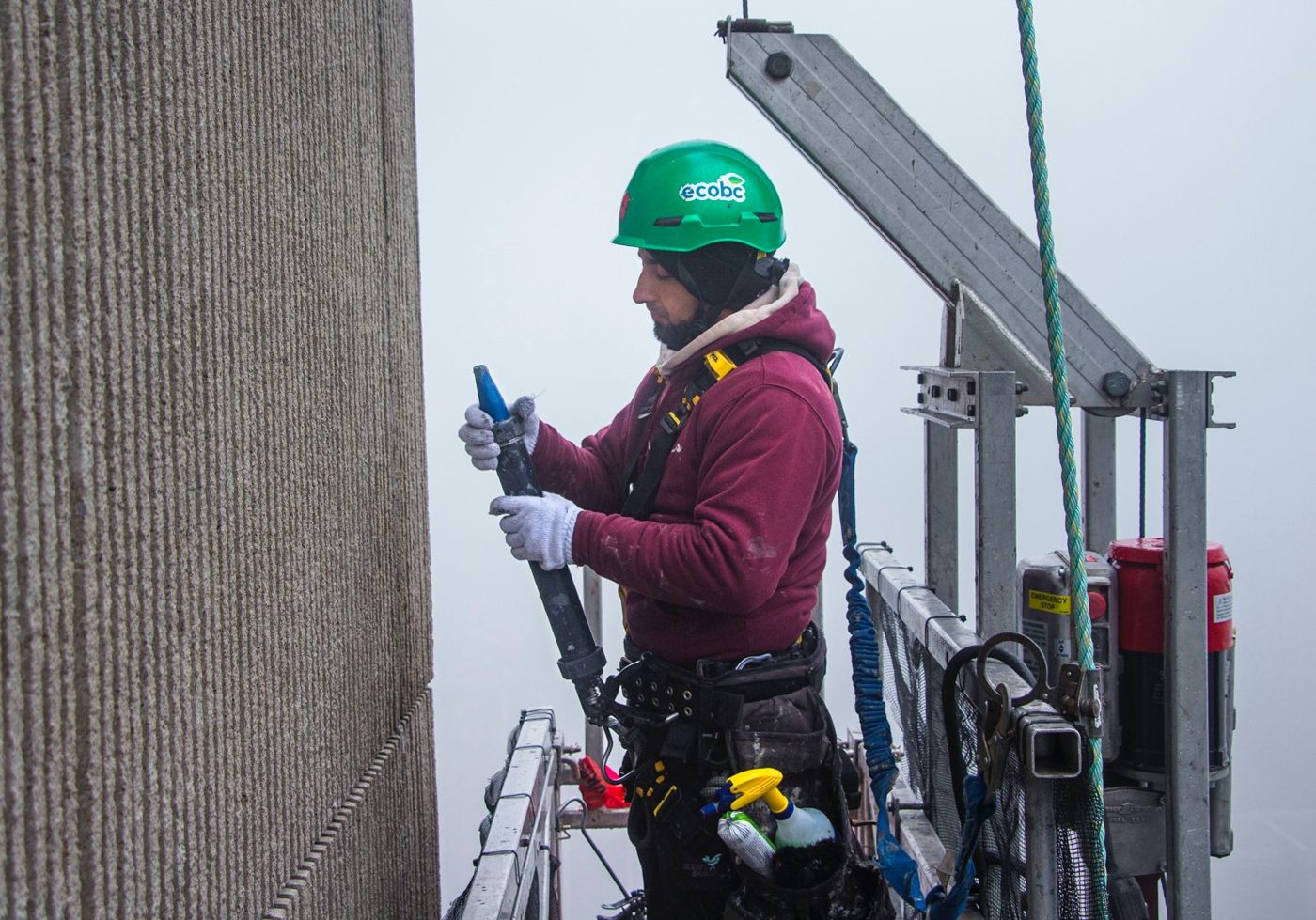
Sealant installation at a window perimeterWindow-perimeter sealant replacement — the joint most PMs see fail first.
What sealant failure looks like

You can see all of this from the ground.

  • Cracking or splitting in the sealant body
  • Sealant peeling away from the surface it was bonded to
  • Missing sections, or obvious gaps in joints
  • Hardened, dried-out sealant with no give when pressed
  • Discolouration or staining running from joint locations
  • Recurring leaks at the same location after a previous repair
  • Multiple generations of patchwork layered on one joint

New sealant over a poor substrate — or over old sealant that wasn't fully removed — looks fine on installation day. It fails years early. The two red items tell you a joint has a history; ask what the substrate underneath looks like.

Surface preparation

A good-looking finished product does not always mean a good installation.

Performance depends on

  • Removal of all failed material
  • Substrate condition and integrity
  • Clean, dry, properly profiled surface
  • Correct primer, backer rod, adhesion
  • Right product, right method

This applies to

  • Sealant and joint systems
  • Waterproofing membranes
  • Traffic toppings and coatings
  • Concrete repair mortars
  • Any system where a bond has to hold for 15 years

The PM lesson

  • None of this is visible after the work is done
  • Poor prep shows up years later as shortened life
  • Labour and preparation matter more than product brand name
  • When two identical scopes differ by 25%, ask where the saving came from
Concrete structure

The 20-year clock nobody can see.

  • Fresh concrete is strongly alkaline, and that alkalinity is what stops the steel inside from rusting
  • Carbonation is the air slowly turning that concrete acidic, working inward from the surface — fastest in the early years, slower the deeper it goes
  • You cannot see it, but it is measurable with a simple field test
  • Once it reaches the steel, rust begins, expands, and cracks the concrete covering it
  • Day to day the drivers are still the simple ones: water and salt
Balconies

An exterior-exposed structural extension of the building.

  • Slab, membrane, railing anchorage, edges, soffits and drains must perform together
  • Cracks start at the weak points — railing post pockets and drip edges — and every crack is a chloride inlet
  • The membrane is the cheapest item on the building: recoat every 5–10 years. Most balcony concrete projects started as a skipped recoat
  • Failing concrete at any height is a life-safety issue
Balcony soffit with exposed reinforcing steel during repairBalcony soffit mid-repair: exposed reinforcing at the edge — year 35 on the slider, in person.
What to look for on balconies

Walk the building with these eight items in mind.

Red items move the question from "when should we fix this" to "is this safe to use right now."

Cracked concrete

Edges, post pockets, soffits. Document and track.

Rust staining

Brown or orange bleeding through concrete: steel is corroding behind it.

Waterproofing wear

Chalking, bare thresholds, blisters, peeling — the recoat window is closing.

Water staining below

On the soffit or the suite ceiling under it — the slab is passing water.

Delamination

Concrete separating in layers; hollow sound when tapped. Often invisible from above.

Spalling

Concrete physically broken off or detached. A falling-debris hazard.

Exposed reinforcing steel

Cover has failed; the corrosion chain is active in the slab.

Guardrail deterioration

Corroded or loose anchorage — professional review before continued use.

Balcony soffit repair with exposed reinforcing steel and membrane termination
Soffit during restoration: exposed reinforcing at the edge, new membrane termination in red.
Masonry, shelf angles, EIFS

Cracked brick can mean more than cracked brick.

  • To the naked eye you see cracked brick. Behind the veneer the cause is often shelf-angle corrosion — the more insidious problem
  • A steel angle at every floor line carries the brick above it; the soft joint beneath it is a sealant joint on the standard 10-year curve, and the only thing keeping water off that steel
  • Rusting steel swells and lifts the courses sitting on it — which is why the cracks appear as clean horizontal lines at the floor levels, following the angle
  • Mortar repointing window: 20–30 years
  • EIFS / stucco — hairline cracks and failed sealant at windows are the inlets. The insulation wets from behind and you see nothing until it blisters or delaminates. EIFS fails from the inside out
Roof and parapet

Why the top few courses spall first.

  • Parapet caps lift and laps open at 8–16 years — small sheet-metal repairs
  • A saturated parapet wets the wall from the top down
  • It isn't only the cap metal: the roofing upturn at the parapet usually fails before the roof field does, so the parapet is a roofing problem as much as a sheet-metal one
  • Modified-bitumen roofs run 15–25 years — good maintenance pushes them toward the long end
  • Roof anchors: annual inspection is regulated (CSA Z91). Out of date = no rope access, no facade work
The parking garage — deck and coatings

The most punishing environment in the building.

  • Water almost year-round, de-icing salt tracked in every winter, constant abrasion, freeze–thaw
  • Not every zone is protected the same: podium deck, ramps, suspended slabs, slab on grade
  • Traffic wear coat: attention every ~5 years in the lanes. Expansion joints under traffic last 10–15 years
  • Maintaining that coating is what keeps de-icing salt away from the steel
  • Once salt reaches the steel it is no longer a coating repair
The parking garage — drains, columns, below grade

Two cheap annual jobs protect the whole garage.

  • Extract the catch basins every year. One or two winters of sand and salt half-fill them — extraction resets that clock completely
  • Blocked drains pond water exactly where the membrane now sits in brine
  • Wash the garage every year. Every passing car throws salt at the bottom 600 mm of every column, and washing it off is the whole defence
  • Foundation cracks: inject early from the inside, before it becomes an excavation from the outside
Why garage deterioration accelerates

The corrosion chain.

Concrete handles compression well and tension poorly. Steel gives it the tensile strength it lacks — until salt and water reach the steel.

1

Moisture + salt in

Salt-laden water penetrates a coating or membrane defect. Salt is an electrolyte — it accelerates everything that follows.

2

Corrosion begins

Chlorides reach the reinforcing steel and break down the passive layer that alkaline concrete provides.

3

Steel expands

Rust occupies several times the volume of the steel it came from — enormous internal pressure.

4

Concrete cracks

Pressure exceeds the concrete's tensile strength. Cracks let more water and salt in. Delamination begins.

5

Spalling

Concrete detaches, exposing more steel. A falling hazard — and a signal the process has been running for years.

Salt-driven garage deterioration is typically more aggressive than anything rainwater does to a facade or a balcony.

Typical service-life expectations

Ranges, not guarantees.

Two buildings built the same year with the same materials can be in dramatically different condition at year 15. The right-hand column is the one that matters.

SystemTypical rangeWhat moves the number
Sealants / joint systems10 – 20 yrsExposure, substrate prep, installation quality, joint movement range
Expansion joints8 – 15 yrsMovement cycles, traffic (garage), salt
Balcony membrane — maintenance cycle5 – 10 yrsUV, foot traffic, thresholds; the cheapest line on the building
Balcony waterproofing system15 – 25 yrsWhether the maintenance happened; drainage; installation quality
Garage traffic coating — maintenance cycle5 – 10 yrsSame idea as the balcony, in a harsher place: lanes and ramps wear first
Garage traffic topping10 – 20 yrsSalt load, vehicle volume, whether the ~5-yr maintenance happened
Sealed glazing units (IGU)15 – 25 yrsPerimeter sealant condition, orientation, gasket quality
Roof membrane (mod-bit)15 – 25 yrsFlashing and penetration sealant maintenance, drainage
Mortar joints20 – 30 yrsParapet condition, exposure, original mix
Localized concrete repair cycle7 – 15 yrsWas the root cause addressed? Quality of prep? Condition of the rest of the system?

Observed condition matters more than any generic number in a reserve table.

Early warning signs

Your field reference. Put it on your phone.

The two that matter most for early detection are recurring leaks and visible patchwork — they tell you the building has a history.

Recurring leaks

Same location, previous repair. The symptom was treated, not the cause.

Visible patchwork

Multiple generations of repair on one element. Ask what's underneath.

Cracked or missing sealant

Split, hardened, pulled away, or gone.

Staining below

Ceilings or walls under a balcony, roof or joint.

Rust staining

Steel is corroding behind the surface and migrating out.

Spalled or loose concrete

Detached material anywhere overhead.

Exposed reinforcing

Cover has failed; corrosion is active.

Worn traffic topping

Bare lanes, peeling at ramps, blisters.

Efflorescence

White mineral deposits — moisture is moving through. A clue, not a cause.

Falling or tripping hazards

Anything at grade or overhead that a resident could meet.

Repairs getting more frequent

An older system needing attention every year is telling you something.

Standing water

Ponding on a deck, roof or balcony — the membrane under it is dying.

The central decision

Maintenance, localized repair, or rehabilitation.

Good maintenance buys time. Bad maintenance wastes money. Properly executed localized repair is a completely reasonable strategy — until the pattern changes.

Localized repair makes sense when

  • Deterioration is genuinely limited and isolated
  • The broader system still has meaningful useful life
  • The repair is properly executed, with correct preparation
  • A full replacement is already planned for later
  • New work can realistically carry a meaningful warranty

Consider rehabilitation when

  • There is a repeated history of localized repairs on the same system
  • Failures are no longer isolated — they are spreading
  • Prior patching has created a "Swiss cheese" condition
  • A meaningful warranty is no longer realistic on new patches
  • New work will likely be removed when full replacement arrives

Continuing to patch a system in decline isn't maintaining the building. It's deferring a larger project while spending money that won't contribute to the eventual solution.

The cost of deferring too long

Deferring isn't irrational. But know what you're trading away.

  • Recurring interior water damage and resident complaints
  • Accelerated deterioration of adjacent components
  • A larger scope — and a larger price — when the work finally happens
  • Emergency response instead of planned, budgeted, phased work
  • Reduced warranty value on patchwork
  • Greater liability exposure as conditions worsen
  • Erosion of board confidence in building management

A recurring problem does not always mean a major project is needed today. But repeated patching without understanding the underlying condition can become one of the most expensive decisions a corporation makes.

When to involve an engineer

How you turn a recurring problem into a documented, defensible plan.

Leaks that keep coming back

Repeated repairs that don't hold.

Widespread deterioration

Visible across more than one location or element.

Uncertain root cause

You know where it shows up, not where it starts.

Options to compare

More than one credible repair path on the table.

Major rehabilitation budgeting

Scope, phasing and cost the reserve fund can rely on.

Board justification

Documentation that outlives this board and this manager.

Tendering and specifications

Comparable bids on an identical, written scope.

Quality oversight

Someone independent watching the preparation nobody will see later.

Reports and the questions to ask

A report isn't paperwork. It's a structured decision.

What a good review report does

  • Identifies root cause — where the problem starts, not where it shows up
  • Localized vs. systemic — the distinction that sets the whole strategy
  • Compares options — repair, rehabilitation, replacement, with trade-offs
  • Supports phasing — justifies staged work when full scope can't happen at once
  • Documents the rationale — protects management and the board
  • Serves future boards — continuity for the next manager and the next directors

Walk into every consultant meeting with these

  • What is the root cause?
  • Is this localized or systemic?
  • What are the options — and the trade-offs?
  • What is the likely remaining useful life of the system?
  • What happens if we defer?
  • Can the work be phased?
  • What warranty is realistic on this scope?
  • Repair now, monitor, or plan for rehabilitation?
  • What should we communicate to the board?

These questions move a conversation from "I have a problem" to "I have a plan the board understands."

Comparing quotes

Do not compare price alone.

Once a contractor is mobilized, excluded scope becomes change-order work — and change-order pricing is never tender pricing.

Scope inclusions

What, specifically, is in the base price?

Scope exclusions

What's out — and what does it cost later? Ask for the list in writing.

Surface preparation

How is failed material removed? What prep is actually specified?

Access assumptions

Swing stage, rope, lift, scaffold — does it match the site?

Warranty terms

What's covered, for how long, under what conditions?

Safety and protection

Fall protection, overhead protection, temporary works — included?

Resident disruption

What suite and common-area access is assumed?

Sequencing

Is the order of work compatible with how the building operates?

Exclusions matter as much as inclusions.

Reserve fund planning

A reserve table sets the schedule. What you see on site sets the timing.

Deterioration timelines vary building to building. A manager who knows what to look for can read their own building rather than waiting on the date in the study.

  • Life-cycle tables are averages — a starting point, not a conclusion
  • Well-maintained buildings routinely outperform the range
  • A history of deferred work usually means earlier action than the table says
  • Condition reviews should inform every reserve fund update
  • Phasing decisions change timing, cost and resident impact

Walk into the reserve fund review with three things: the condition you're observing, the repair history of each system, and what the engineering report says about remaining life. That's real input — and it's the input most studies never get.

Working with contractors

Projects succeed on clarity set before day one.

This is pre-construction, and most of it is yours to run. Not every job needs an engineer and not every job goes straight to a contractor — knowing which is which is the judgment that saves money.

1

Clear scope, in writing

"Replace sealant at all window perimeters, floors 3–12." Both sides know what done looks like.

2

Safety first

Fall protection, overhead protection and site hazards agreed before mobilization.

3

Access planning

How the crew reaches the work, and what disruption that means.

4

Resident communication

Advance notice, disruption windows, escalation contacts. This is where managers shine.

5

Sequencing

Order affects cure times, quality and resident impact. Review it before work starts.

6

Site coordination

One named on-site contact on each side when something comes up.

Before the next board meeting

Eight things that don't need an engineering degree.

  • Know which systems matter most on your building — and when each was last addressed
  • Watch known locations for recurring leaks and visible deterioration
  • Learn to tell an isolated issue from a pattern
  • Document repair history — who did what, when, and with what warranty
  • Be cautious of repeated patching as a long-term strategy
  • Ask for clear reporting when a major decision is coming
  • Compare exclusions as carefully as you compare price
  • Help the board decide before an issue becomes an emergency
Questions and discussion

Exterior deterioration is inevitable.
Poor decisions around it are not.

The earlier deterioration is understood, the more options a manager and board have to control cost, timing and risk.

QR code to ecobc.ca/seminar
Take the building with you
ecobc.ca/seminar
Every element, forty years, on your phone.
Drag, tap a marker, slide the years.
If there's a building you're unsure about
We'll walk it with you — a facade or garage review, on site, no charge. You leave with a plain-language read on where each system sits on the curve.
Christian Coldea
ecobc Restoration and Maintenance · info@ecobc.ca · ecobc.ca
Ali Shahbazi, P.Eng., LEED AP
Owner and Principal Engineer
Slide1 / 28 Target1 min Elapsed00:00 Plan0 min